Stages per level
Personal templates, tenant templates and platform templates each have their own approval chain. It consists of stages that are passed one after the other – first a subject-matter review, for example, then approval by the head of quality. As long as one stage is not complete, the next cannot begin. A level without stages publishes submitted revisions immediately.
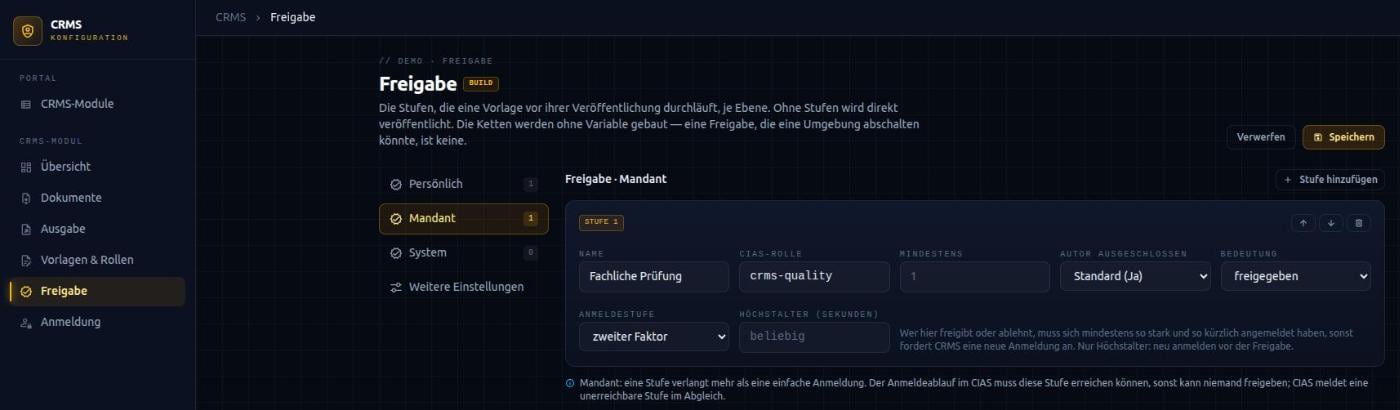
Each stage describes exactly what it requires:
- Role: whoever holds the stage’s role may approve or reject there.
- Minimum number: how many different people have to agree.
- Author excluded: by default, nobody may approve their own revision.
- Meaning: whether an approval states “reviewed” or “approved”.
- Sign-in level and maximum age: whether approval is only possible with a second factor or a phishing-resistant method, and how recent the sign-in has to be.
Four eyes that really are four
A person approves a revision only once, even if they hold the roles of several stages. Otherwise two stages with the same person would be just one pair of eyes. Every approval is recorded in the revision’s chain with person, time and meaning, and it is bound to exactly the content that was approved.
Rejecting is possible at every stage and always requires a reason. The rejected revision stays in the history with reason and person; a new attempt is a new revision. Personal templates are reviewed by the reviewers of the respective tenant – they cannot otherwise see the template, but they can approve it.
Approval as a deliberate act
If a stage requires a stronger or more recent sign-in, the system asks the person to sign in accordingly before approving. The approval is then sent again. Technical accounts cannot pass such a stage: an approval is the decision of a human being.
Defined when the system is assembled
Approval chains belong to the project. You define them in the CodamAI Hub, and they take effect with the next build. A single environment deliberately cannot switch them off – an approval chain that can be switched off would not be one.
Every submitted revision carries the chain that applied when it was submitted. A later change to the chain only affects new revisions. This keeps it traceable, even years later, which review a revision went through. It supports controlled change processes of the kind quality management systems call for; assessing it for your specific use remains part of your own quality process.